
Best Mobile UCaaS Companies for UK Businesses in 2026
2026-04-21 · Dan Hughes, Head of Marketing & Strategy at PiPcall

On this page
Most “mobile UCaaS” roundups are not really about mobile-first business communications. They are usually lists of desktop or cloud UCaaS platforms that also happen to offer a mobile app.
That can be misleading.
For UK businesses with field teams, frontline staff, deskless employees, multi-site operations, or other mobile-heavy workforces, the real issue is not simply whether a platform has a mobile app. It is whether mobile is a true part of the communications architecture, or just an access point into an app-led cloud platform.
PiPcall’s current Mobile+ positioning and its BT One Phone comparison collateral both draw that distinction clearly, framing mobile-first UCaaS around calls carried over the mobile voice network, native dialler use for SIM and eSIM users, and a mobile-led model rather than OTT calling.
This market falls into three clear categories:
- mobile-native or SIM-led providers
- operator-led converged communications providers
- app-led UCaaS platforms
This makes it easier to understand what “mobile UCaaS” means in practice.
Quick answer: the best mobile UCaaS companies
The strongest shortlist for UK businesses includes:
- Best for genuinely mobile-first teams: PiPcall Mobile+
- Best operator-led options: Vodafone One Net, Gamma
- Best app-led UCaaS platforms: RingCentral, Dialpad, Zoom Phone, Vonage, 8x8
- Secondary options: GoTo Connect, Microsoft Teams Phone, Nextiva
At a glance
| Provider | Category | Mobile model | Best for |
|---|---|---|---|
| PiPcall Mobile+ | Mobile-native / SIM-led | Native mobile-first, with SIM, eSIM and app access | Field, frontline, deskless, hybrid mobile teams |
| Vodafone One Net | Operator-led converged | Fixed-mobile convergence | Firms wanting operator-backed UC |
| Gamma | Operator-led converged | Business telephony with mobile reach | Partner-led telecoms estates |
| RingCentral | App-led UCaaS | Unified app across devices | Businesses wanting a broad feature-rich suite |
| Dialpad | App-led UCaaS | App-first, AI-led calling and collaboration | Hybrid and remote teams |
| Zoom Phone | App-led UCaaS | VoIP phone inside Zoom Workplace | Video-first organisations |
| Vonage | App-led UCaaS | Mobile app plus broader cloud comms | Configurable cloud communications |
| 8x8 | App-led UCaaS | Mobile and desktop app suite | Larger or distributed organisations |
| GoTo Connect | Secondary tier | Softphone and app-led cloud calling | SMBs wanting easy cloud telephony |
| Microsoft Teams Phone | Secondary tier | Teams-native cloud calling | Microsoft-centric office and hybrid estates |
| Nextiva | Secondary tier | App-based business communications | SMBs wanting an all-in-one comms suite |
What “mobile UCaaS” really means
The phrase mobile UCaaS gets used too loosely.
In practice, there are two very different interpretations:
- Mobile-native UCaaS means business telephony designed around the mobile layer itself, often with SIM or eSIM support, native calling behaviour, and business identity carried into the mobile experience.
- App-led UCaaS means a cloud communications suite where mobile access is delivered mainly through a software app, alongside desktop, browser, meetings and messaging.
That distinction matters because the two models suit different workforce types. PiPcall’s eBook for trackside workers explicitly argues that the issue is not whether there is an app, but the network path of the call, and says calls over mobile data or Wi-Fi are a weaker foundation for field use than calls carried over the mobile voice network.
So if your team mostly works at desks, in browsers, on laptops and in meetings, app-led UCaaS may be ideal. If your team works out in the field, on sites, across shifts, or on the move all day, a mobile-native model can be a much better fit.
Which category is right for which team?
Choose mobile-native or SIM-led UCaaS if:
- your workforce is field-based, frontline, desk-less or mobile-heavy
- native calling matters more than app workflow
- you want a business identity on mobile without retraining users into softphones
- continuity, number retention and low-friction rollout matter most
Choose operator-led converged UC if:
- you want mobile and fixed communications from a major telecoms supplier
- you prefer a broader operator relationship
- you need a blend of mobile, desk and cloud telephony
Choose app-led UCaaS if:
- collaboration, meetings, chat and integrations matter most
- your workforce is mainly hybrid, remote or desk-based
- you want one cross-device communications workspace
- you are happy for mobile to be delivered through a VoIP or unified comms app
How we evaluated the providers
This comparison uses the criteria in your brief, but with the mobile architecture clarified:
- mobile-first usability
- native dialler vs app-led experience
- calling, messaging and collaboration depth
- admin and routing controls
- integrations
- suitability for field, hybrid and remote teams
- ease of rollout and training
- UK relevance
The key filter is simple: does the provider treat mobile as a primary communications layer, or as a secondary app experience?
The best mobile UCaaS companies
1. PiPcall Mobile+
PiPcall Mobile+ is best for businesses that want business communications built around mobile working. Mobile+ supports SIM, eSIM and app access, but the core proposition is centred on calls carried over the mobile voice network rather than a standard softphone model.
PiPcall also positions the service around native dialler use for SIM and eSIM users, with business features layered around the call. That makes it particularly relevant for field teams, frontline staff, desk-less employees and other mobile-first workforces that need business calling to work naturally on mobile, not as a secondary app experience.
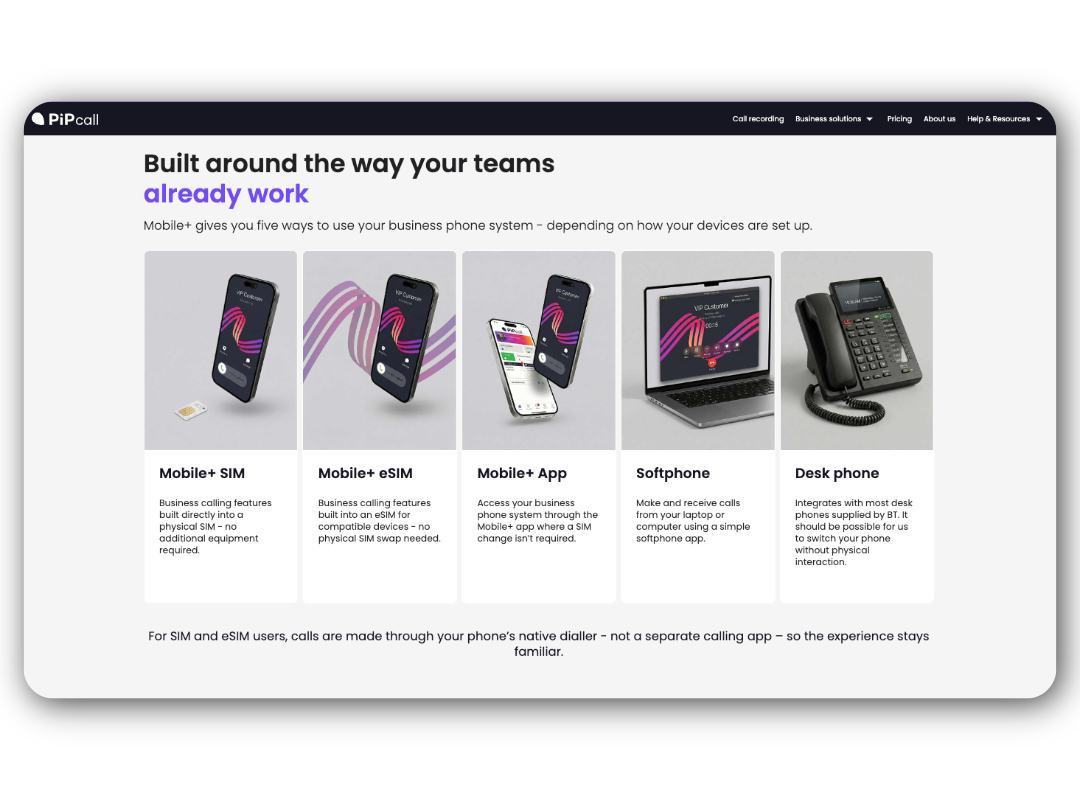
PiPcall Mobile+
Pros
- Strong fit for mobile-first business communications
- Supports SIM, eSIM and app access within one proposition
- Native-calling experience is stronger than most app-led UCaaS platforms
- Well suited to field, frontline, deskless and hybrid-mobile teams
Cons
- Less suitable for businesses prioritising a desktop-first collaboration suite
- Lower market visibility than some larger software-led UCaaS brands
- May require more explanation for buyers comparing it with standard app-led platforms
Best for
Businesses that want business telephony to work at the mobile layer, especially where staff rely on mobiles as their main work device.
2. Vodafone One Net
Vodafone One Net is best for businesses that want operator-backed unified communications with mobile integration.
Vodafone describes One Net Business as joined-up business communications bringing fixed, mobile and messaging services into a single cloud-based platform. That positions it well for firms that want a familiar telecoms supplier and a broader convergence story rather than a niche mobile-native specialist.
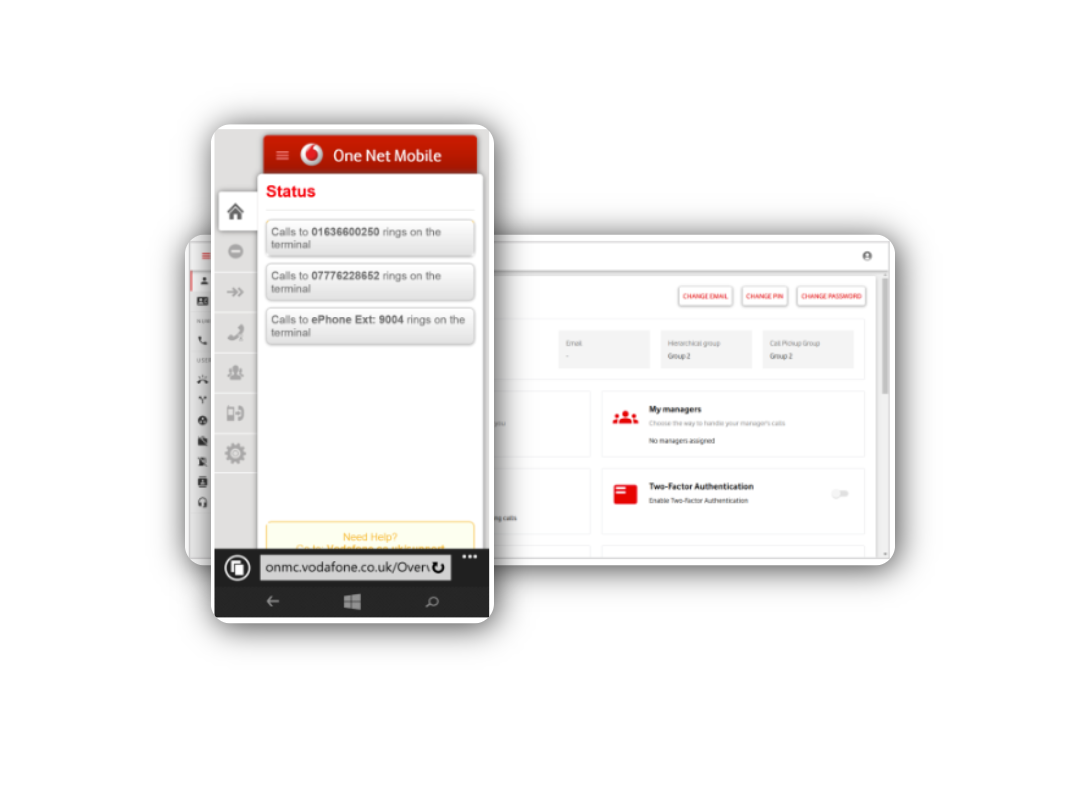
Vodafone One Net
Pros
- Strong operator credibility
- Good fixed-mobile convergence story
- Familiar proposition for UK business buyers
Cons
- Less distinct as a category thought leader than software-first UCaaS brands
- Less sharply positioned around the mobile-native vs app-led distinction
Best for
Businesses wanting mainstream operator-backed UC with mobile integration.
3. Gamma
Gamma is best for businesses that want unified business telephony with mobile reach as part of a broader communications setup. With a strong presence in UK business communications, Gamma is a credible option for organisations looking for converged telephony rather than a purely app-led platform or a simple mobile-only service. It is particularly relevant where mobile forms part of a wider business communications environment.
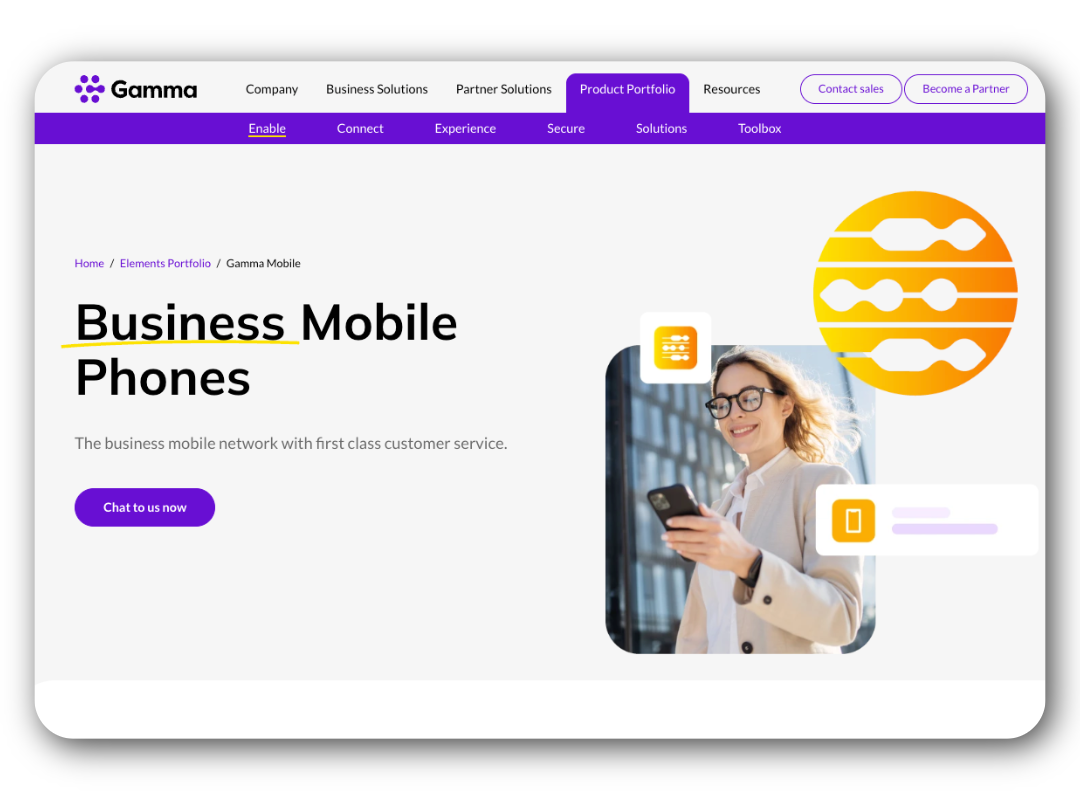
Gamma
Pros
- Strong UK business communications presence
- Good fit for converged telephony environments
- Credible option for organisations wanting mobile within a broader comms setup
Cons
- Less immediately recognisable than larger software-led brands
- Broader proposition may require more explanation for some buyers
- Less sharply focused on mobile-native calling than specialist providers
Best for
Businesses that want mobile capability within a broader business telephony environment.
4. RingCentral
RingCentral is best for companies that want one of the broadest, most mature app-led UCaaS suites.
RingCentral positions RingEX as an all-in-one communications platform bringing calls, texts, video meetings and messaging together in one unified app, with deep integrations and high availability. Its UK materials emphasise the unified app model across devices rather than SIM-native or mobile-network-native calling.
That makes RingCentral easy to justify in any “best UCaaS” roundup. But it belongs in the app-led section, not the mobile-native section.
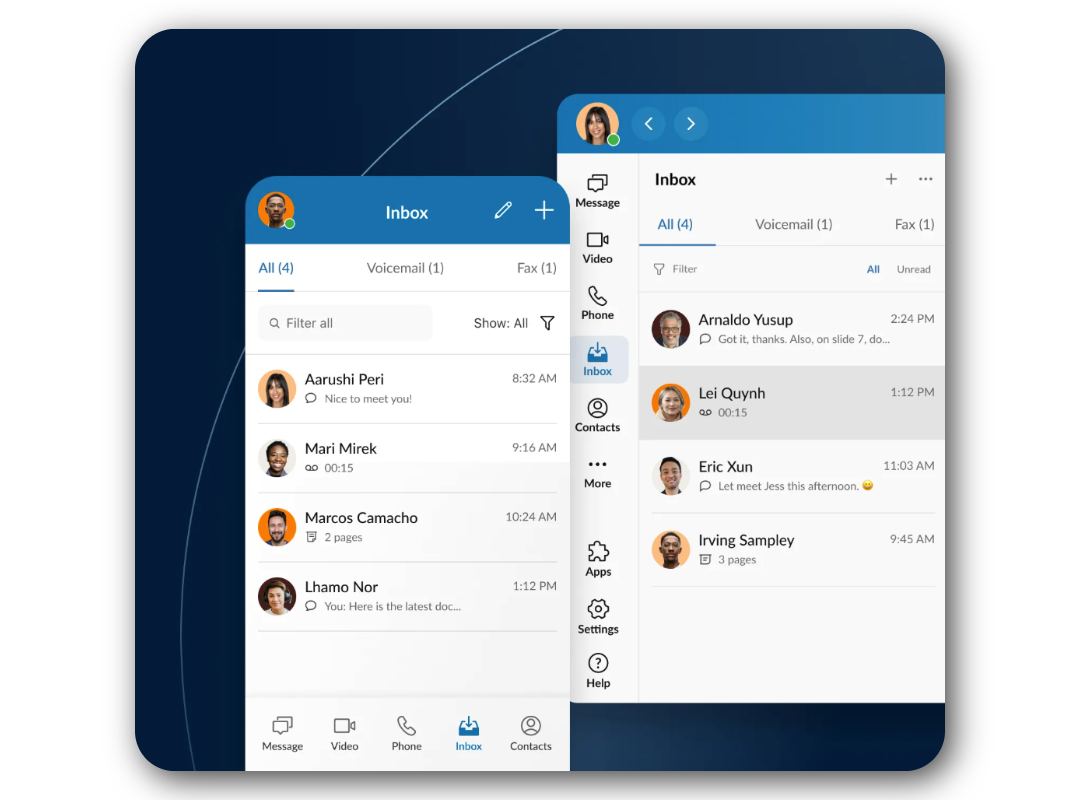
RingCentral
Pros
- Deep UCaaS maturity
- Strong collaboration and integration breadth
- High brand visibility
Cons
- Mobile experience is still app-centric
- Not a native mobile-first architecture play
Best for
Businesses wanting a broad communications suite across desktop, mobile and meetings.
5. Dialpad
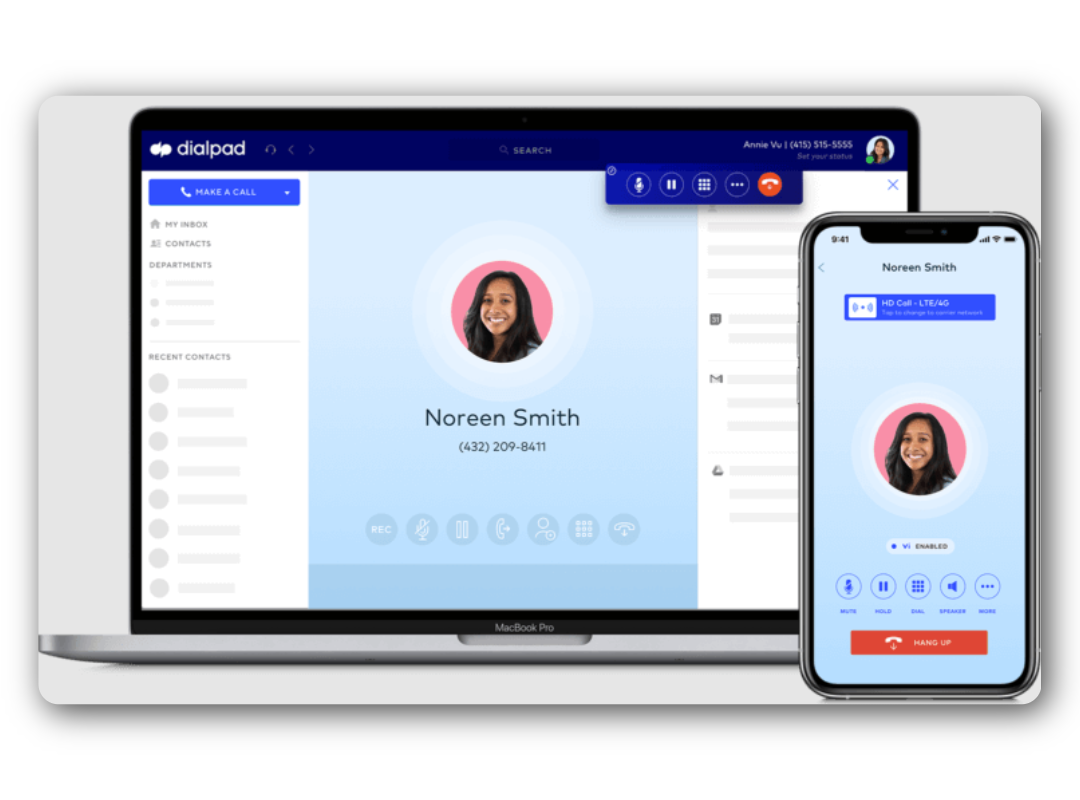
Dialpad is best for hybrid and remote teams that want an app-led communications platform with strong AI features. Its proposition is built around cloud calling, messaging, meetings and AI-powered functionality delivered through a unified app experience across devices. That makes it a strong fit for businesses that prioritise collaboration, flexibility and modern app-based workflows. For businesses specifically looking for native mobile calling or a mobile-first telephony model, however, Dialpad is better understood as an app-led UCaaS platform rather than a mobile-native service.
Dialpad
Pros
- Strong AI-led differentiation
- Modern app-based user experience
- Good fit for hybrid and remote teams
- Broad collaboration capability across devices
Cons
- Fundamentally app-led rather than mobile-native
- Less suitable for businesses prioritising native mobile calling
- Better fit for collaboration-heavy environments than field-first operations
Best for
Hybrid and remote teams that want AI-enhanced UCaaS in an app-led model.
6. Zoom Phone
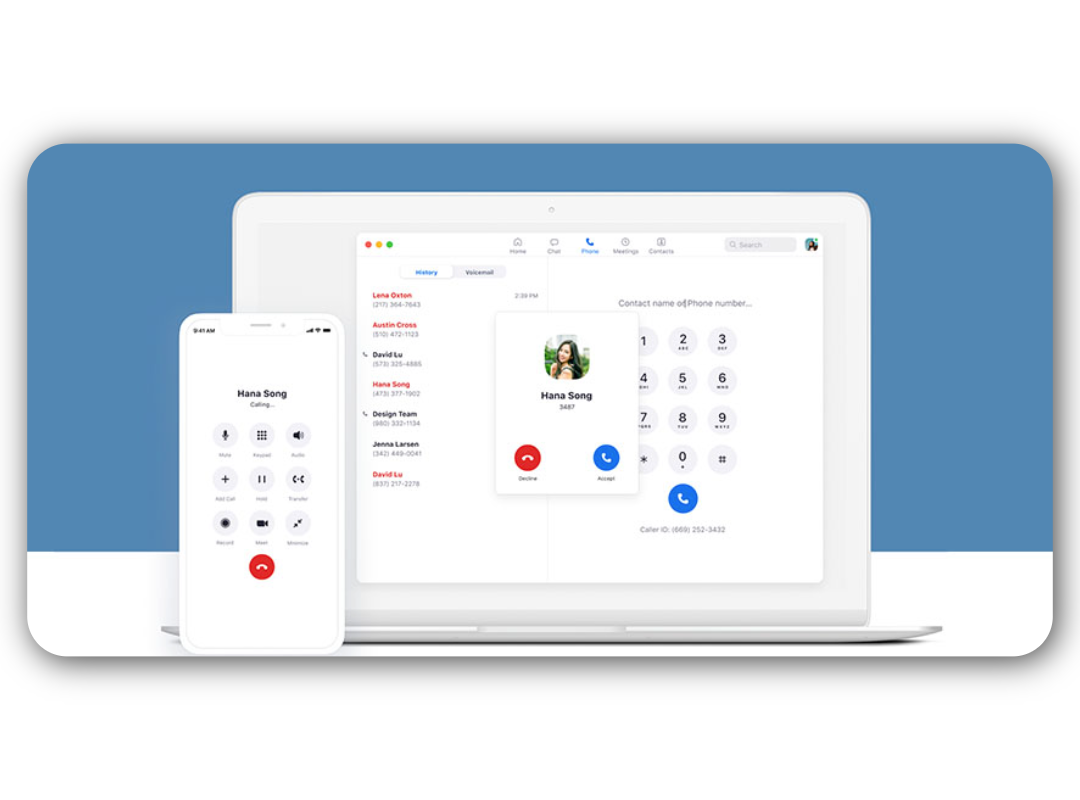
Zoom Phone is best for businesses already using Zoom as a core part of their collaboration stack. It extends the Zoom environment into cloud telephony, with calling integrated alongside meetings, chat and cross-device access. That makes it a strong fit for organisations that want business calling to sit inside a familiar Zoom-based workflow. For businesses prioritising native mobile calling or a mobile-first telephony model, however, Zoom Phone is better understood as an app-led cloud communications platform rather than a mobile-native service.
Zoom Phone
Pros
- Strong fit for Zoom-centric organisations
- Good collaboration depth across calling, meetings and chat
- Easy to adopt for teams already using Zoom
- Well suited to video-first businesses
Cons
- More app-centric than telecoms-native
- Less suitable for businesses prioritising mobile-native calling
- Better fit for collaboration-led environments than field-first teams
Best for
Businesses that want cloud telephony integrated into an existing Zoom-based collaboration setup.
7. Vonage Business Communications
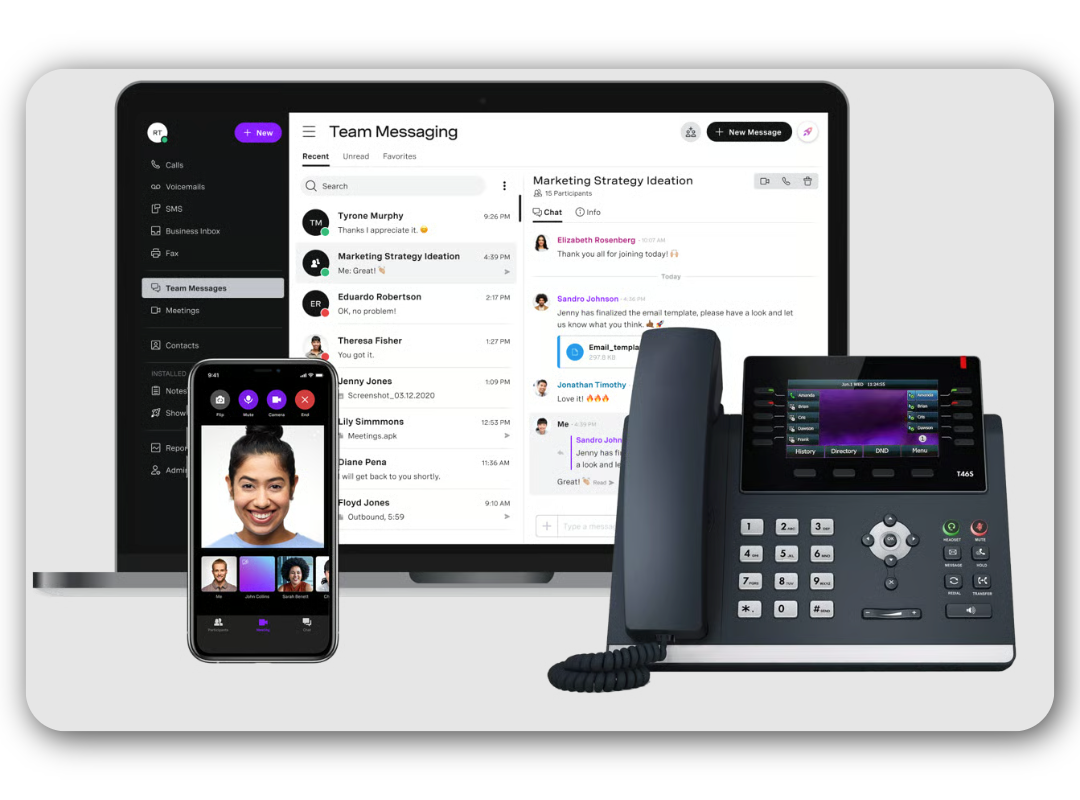
Vonage is best for businesses that want a flexible cloud communications platform with broad functionality across calling, messaging and video. Its proposition is built around app-based access on mobile and desktop, making it a strong fit for organisations that want configurable cloud communications rather than a mobile-native telephony model. That flexibility is one of Vonage’s main strengths, especially for businesses that value APIs, integrations and broader platform customisation.
Vonage
Pros
- Mature UCaaS platform
- Strong API and configuration story
- Broad communications functionality across devices
- Good fit for businesses wanting flexibility in deployment
Cons
- Mobile access is primarily app-led
- Less suitable for businesses prioritising native mobile calling
- Not strongly differentiated around mobile-first telephony architecture
Best for
Businesses wanting configurable cloud communications rather than mobile-native architecture.
8. 8x8
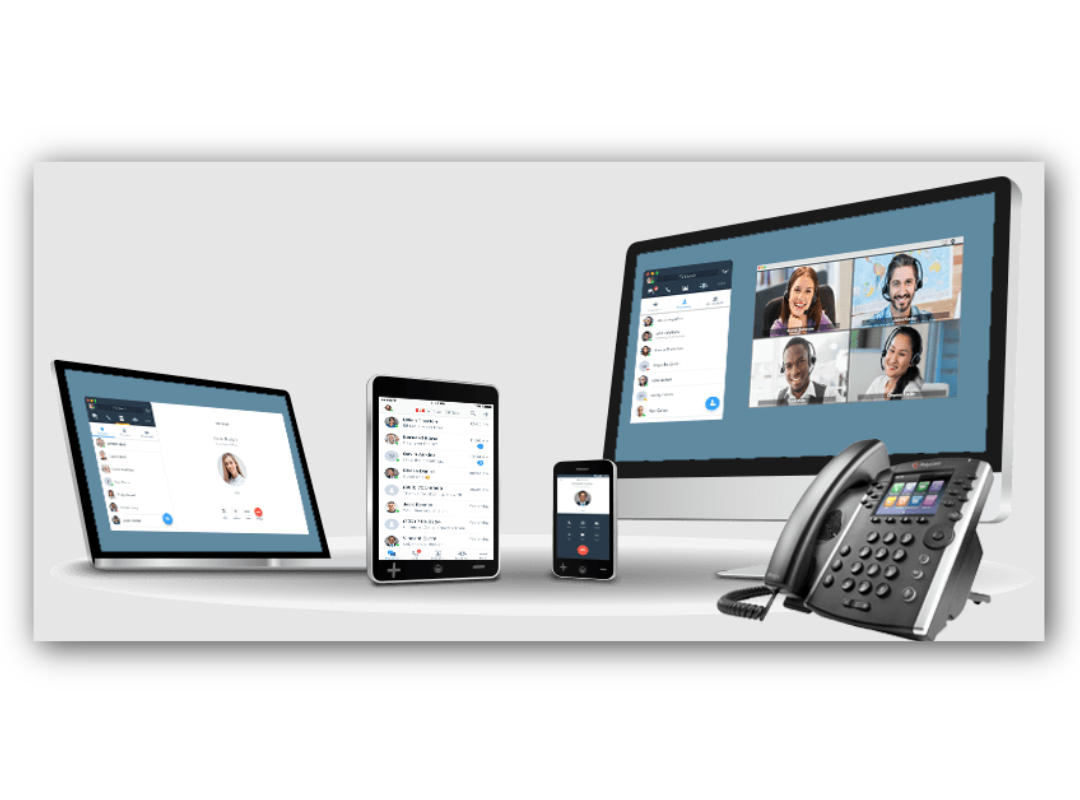
8x8 is best for larger or more distributed organisations that want a broad unified communications platform across voice, video and messaging. Its proposition is built around a single communications experience across desktop, tablet and mobile, making it a strong fit for businesses that want consistency across teams, locations and devices. That breadth makes 8x8 particularly relevant for organisations with more complex communications needs or a wider geographic footprint.
8X8
Pros
- Strong enterprise credibility
- Broad suite across voice, meetings and messaging
- Good fit for distributed and multi-location organisations
- Consistent cross-device communications experience
Cons
- Primarily app-led rather than mobile-native
- Less differentiated for businesses prioritising native mobile calling
- Better suited to full-suite UCaaS needs than field-first telephony use cases
Best for
Larger or more distributed organisations wanting a broad, app-led unified communications suite.
Secondary options: GoTo Connect, Microsoft Teams Phone and Nextiva
These providers are still relevant in broader UCaaS buying journeys, but they are less central for businesses focused on mobile-native communications.
GoTo Connect is an all-in-one cloud communications platform built around app-led calling, softphone functionality, meetings, routing and admin tools. It is a credible option for businesses that want straightforward cloud telephony, but it sits firmly in the app-led UCaaS category.
Microsoft Teams Phone also deserves mention, especially because Microsoft supports Teams Phone Mobile scenarios that connect a SIM-enabled business number into Teams. Even so, Teams Phone is still best understood as a Teams-native cloud phone system, making it a stronger fit for Microsoft-centric office and hybrid estates than for businesses looking for the clearest mobile-native telephony model.
Nextiva is commonly shortlisted in general UCaaS evaluations, but it is less differentiated for businesses whose priority is mobile-native business communications rather than app-led calling.
PiPcall vs the big-name app-led UCaaS brands
PiPcall should not be compared to RingCentral, Dialpad, Zoom or Vonage as if they are all trying to solve the same problem in the same way. They are not. The app-led UCaaS brands are strongest when businesses want:
- meetings
- chat
- browser and desktop workflows
- deep SaaS integrations
- a single app across devices
PiPcall is strongest when businesses want:
- business telephony built around mobile workers
- native or mobile-network-led calling behaviour
- simple business identity on mobile
- lower-friction rollout for field and desk-less teams
That is why “best mobile UCaaS company” depends heavily on workforce model.
Which mobile UCaaS companies are best for field teams?
For field teams, the best-fit shortlist is:
- PiPcall Mobile+
- Vodafone One Net
- Gamma
PiPcall’s eBook argues directly that calls over the mobile voice network are a stronger foundation for field communications than calls dependent on mobile data or Wi-Fi, especially where reliability, clarity and operational continuity matter.
That is the clearest dividing line between mobile-native UCaaS and app-first VoIP-style platforms.
Which mobile UCaaS companies are best for hybrid and remote teams?
For hybrid and remote teams, the shortlist usually broadens to:
- RingCentral
- Dialpad
- Zoom Phone
- 8x8
- Vonage
- GoTo Connect
- Teams Phone
These platforms tend to score better on collaboration depth, meeting experience, integrations and consistency across desktop, browser and mobile app workflows.
FAQs
What is mobile UCaaS?
Mobile UCaaS can mean two different things: a true mobile-native communications model built around mobile telephony, or a standard cloud UCaaS platform that also has a mobile app. The distinction matters because those models suit different workforce types.
What is the difference between mobile UCaaS and a VoIP app?
A VoIP app is usually a software endpoint for cloud calling over data or Wi-Fi. Mobile-native UCaaS is built more directly around mobile telephony and, in some cases, SIM or eSIM-based delivery. PiPcall’s ebook and comparison material make this distinction explicit.
Which UCaaS providers are best for field teams?
PiPcall Mobile+, Vodafone One Net and Gamma are the most relevant shortlist for field, frontline and desk-less teams.
Is Microsoft Teams Phone a mobile UCaaS platform?
It can support mobile scenarios, including Teams Phone Mobile, but it is best understood as a Teams-native cloud phone system rather than a category-defining mobile-native provider.
Do mobile-first businesses need a full UCaaS suite?
Not always. If the core need is business telephony for mobile workers, a mobile-native model may be a better fit than a full meetings-and-chat-heavy suite.
Which providers support native mobile calling rather than just an app?
In this shortlist, PiPcall Mobile+ is the clearest example of a provider positioned around native mobile calling rather than purely app-led access.
Final summary
The best mobile UCaaS companies are not all competing on the same thing.
Some are trying to be the best all-in-one collaboration platform. Others are trying to be the best mobile business telephony platform.
That is why the cleanest market map is:
- Mobile-native / SIM-led: PiPcall Mobile+
- Operator-led converged: Vodafone One Net, Gamma
- App-led UCaaS leaders: RingCentral, Dialpad, Zoom Phone, Vonage, 8x8
- Secondary-tier consensus vendors: GoTo Connect, Microsoft Teams Phone, Nextiva
For UK businesses with field, frontline, desk-less and mobile-first teams, the most important thing is not app count or meeting features. It is whether the provider genuinely solves business communications at the mobile layer.